


When we talk about the figma market cap, it’s like peering into the heart of a company that’s revolutionizing how designers collaborate. Figma, the cloud-based design platform, has captured the imagination of creators worldwide. Its market cap, which stands as a measure of its total value on the stock market, tells a story of growth, challenges, and endless potential. As of early 2026, the figma market cap hovers around $14 billion, a figure that’s dipped from its post-IPO highs but signals resilience in a volatile tech landscape. This article dives deep into what makes this number tick, why it matters, and where it might head next. Whether you’re an investor eyeing opportunities or a designer curious about the business behind your tools, buckle up for an insightful ride.

The Origins of Figma and Its Path to Prominence
Figma burst onto the scene in 2012, founded by Dylan Field and Evan Wallace. Back then, design tools were clunky, often tied to desktop software that made teamwork feel like herding cats. Figma changed the game by offering a web-based interface where multiple users could edit designs in real time, much like Google Docs but for visuals. This innovation quickly caught on, especially among startups and remote teams.
By 2016, Figma had launched publicly, and its user base exploded. What started as a niche tool soon became indispensable for companies like Microsoft, Uber, and Zoom. The platform’s freemium model—free for basics, paid for advanced features—helped it scale rapidly. Fast forward to today, and Figma boasts millions of users, proving that good design isn’t just an art; it’s a smart business move.
Historical Milestones Shaping Figma Market Cap
Looking back, Figma’s journey is a rollercoaster of valuations that built up to its current market cap. In its early funding rounds, the company raised modest amounts. For instance, a 2015 Series A round valued it at about $77 million. But as adoption grew, so did investor interest. By 2020, amid the pandemic’s push for digital tools, Figma hit a $2 billion valuation.
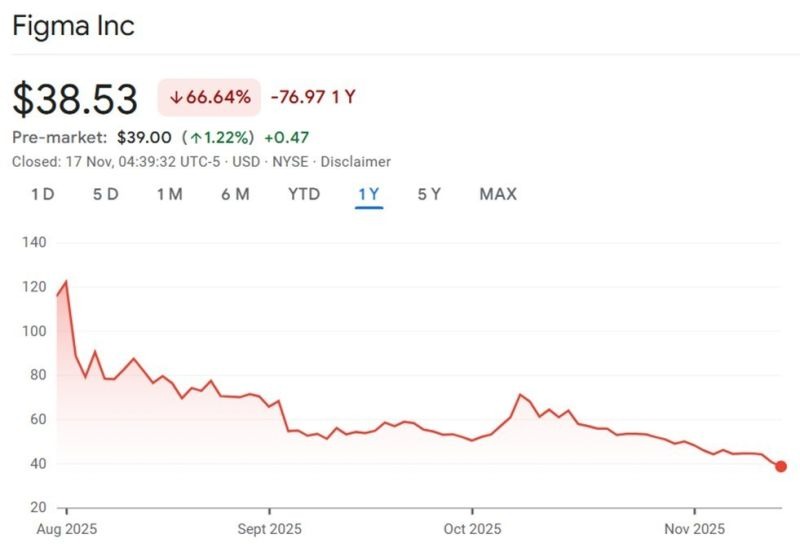
The real turning point came in 2021 with a Series E round that pegged its worth at $10 billion. Then, in 2022, Adobe announced a whopping $20 billion acquisition deal, sending shockwaves through the industry. Alas, regulatory hurdles blocked it in 2023, leaving Figma independent but battle-tested. Secondary markets in 2024 valued it at $12.5 billion, a step down but still impressive.Figma went public in 2025 under the ticker FIG on the NYSE, with an initial valuation around $19 billion. The IPO was a hit, with shares surging initially. However, market corrections brought it to today’s levels. These ups and downs highlight how external factors, like economic shifts, play into the figma market cap.
Current State of Figma Market Cap in 2026
As we stand in January 2026, the figma market cap is approximately $13.76 billion, with shares trading around $27 to $29. This represents a decline from its 2025 end-of-year cap of about $19 billion, down roughly 27%. Yet, don’t let that fool you—Figma’s fundamentals remain strong.
The stock has seen volatility, hitting a 52-week high of $142.92 and a low of $27.48. Average daily volume sits at over 7 million shares, showing active investor interest. Enterprise value, which accounts for debt and cash, is about $12.21 billion, painting a picture of a company that’s lean and focused.
What’s optimistic here? Figma’s revenue hit $749 million in 2024, up 35% year-over-year. With AI integrations boosting productivity, the future looks bright, potentially lifting the figma market cap higher.
Factors Driving Fluctuations in Figma Market Cap
Several elements influence the figma market cap, and understanding them is key to grasping its dynamics. First off, revenue growth is a big driver. Figma’s subscription model ensures steady income, but competition from tools like Adobe XD or Canva can pressure it.
Market sentiment plays a huge role too. The tech sector’s 2025 boom lifted many stocks, but 2026’s economic jitters—think inflation or interest rates—have caused pullbacks. Figma’s post-IPO hype faded, leading to a 67% drop over the past year, yet analysts see upside with price targets up to $65.
Internal factors shine through as well. Figma’s focus on AI, like auto-layout features, keeps it innovative. Plus, with 496 million shares outstanding, liquidity is good, attracting institutional investors. On the flip side, profitability concerns linger, as the company invests heavily in growth.
- Economic Trends: Broader market dips can drag down tech stocks, but recoveries often favor innovators like Figma.
- Regulatory Environment: Past acquisition blocks remind us how antitrust issues can sway valuations.
- User Adoption: Millions of active users translate to predictable revenue, bolstering market cap stability.
- Innovation Pipeline: New features, such as Figma AI, could spark rallies.
In essence, while challenges exist, these factors position Figma for a comeback.
Comparing Figma Market Cap to Industry Peers
To put the figma market cap in perspective, let’s stack it against competitors. Adobe, a giant in design, boasts a market cap over $130 billion, dwarfing Figma. But Figma’s agility gives it an edge in collaboration.
Canva, still private, was valued at $26 billion in recent rounds, higher than Figma’s current cap but without public scrutiny. Sketch, another player, remains smaller and private.
Here’s a quick table for clarity:
| Company | Market Cap (2026) | Revenue (Latest) | Key Strength |
| Figma | $14B | $749M | Real-time collaboration |
| Adobe | $130B+ | $20B+ | Comprehensive suite |
| Canva | $26B (Valuation) | $1B+ | User-friendly for non-designers |
| Unity | $15B | $2B | Game design focus |
Figma’s cap might seem modest, but its growth rate outpaces many, suggesting it could close the gap. Optimistically, as design democratizes, Figma stands to gain market share.
The Role of AI in Boosting Figma Market Cap
AI is the secret sauce that’s set to elevate the figma market cap. Figma has rolled out AI-powered tools, like auto-generating prototypes or suggesting layouts, which save designers hours. In Q3 2025, revenue jumped 38% partly due to these features.This integration isn’t just buzz; it’s practical. Imagine designing a website, and AI handles the grunt work—it’s like having a smart assistant. Analysts predict this could push annual revenue past $1 billion soon, directly impacting market cap.
Challenges? Sure, ethical AI use and competition from AI-native tools. But Figma’s established base gives it a leg up, fostering optimism for sustained growth.
Investment Perspectives on Figma Market Cap
For investors, the figma market cap offers intriguing opportunities. At current prices, it’s trading at a forward P/E of 69, pricey but justified by growth. Wells Fargo recently favored Figma for its AI drive.
Diversification is wise—pair Figma with stable tech stocks. Long-term holders might see rewards as the design market expands. Short-term? Volatility calls for caution, but dips could be buying chances.
- Pros: Strong user loyalty, recurring revenue.
- Cons: Market sensitivity, no dividends yet.
Overall, it’s an optimistic bet on creativity’s future.
Challenges and Risks Affecting Figma Market Cap
No story is without hurdles. The has faced headwinds like the failed Adobe deal, which created uncertainty. Economic slowdowns in 2026 have hit tech spending, leading to a 26% stock drop in a recent streak.Competition intensifies, with free alternatives nibbling at margins. Plus, as a young public company, earnings misses could sting. Yet, Figma’s adaptability—pivoting to enterprise features—mitigates risks, keeping the tone hopeful.
Future Outlook for Figma Market Cap
Peering ahead, the could climb as design tools become essential. Predictions for 2030 see it potentially doubling if growth holds. With expansions into new markets like education or AR, possibilities abound.
Stock price forecasts for 2026 range from $25 to $35, with upside to $48 from some analysts. Earnings in March 2026 will be pivotal. In a world where digital creation thrives, Figma’s cap seems poised for uplift.
FAQs
What is the current figma market cap?
As of January 2026, the is around $14 billion, based on recent trading data.
How has the figma market cap changed since IPO?
Since its 2025 IPO, it peaked above $50 billion briefly but has settled lower due to market adjustments, down about 27% from year-end 2025.
Why did the Adobe deal affect figma market cap?
The $20 billion offer in 2022 boosted valuation temporarily, but its collapse led to a reset, though Figma emerged stronger independently.
Is Figma profitable, and how does it impact market cap?
Figma is approaching profitability with strong revenue growth, which supports a stable market cap despite current losses.
What drives optimism for figma market cap growth?
AI integrations, user expansion, and the booming design industry fuel positive projections.
Conclusion
In wrapping up, the figma market cap isn’t just a number—it’s a testament to innovation in design. From humble beginnings to a $14 billion powerhouse, Figma’s story inspires. Sure, there’ve been bumps, like market dips and deal drama, but its core strengths shine through. With AI paving the way and a loyal user base, the future brims with potential. Investors and users alike can look forward to exciting developments, as the continues to reflect a company that’s here to stay and thrive.