

When it comes to investing in the tech-heavy Nasdaq-100 Index, folks often find themselves weighing QQQM vs QQQ performance. These two exchange-traded funds, or ETFs, from Invesco have captured the attention of investors looking for growth in innovative sectors. Hey, it’s no secret that the stock market can feel like a roller coaster, but understanding these options can help you ride it out smoothly. In this detailed article, we’ll dive deep into what makes each one tick, compare their track records, and offer insights to guide your decisions. By the end, you’ll see why both hold promise, especially in a world that’s always pushing forward with new ideas.
Understanding the Nasdaq-100 Index
Before we jump into the nitty-gritty of QQQM vs QQQ performance, let’s get a handle on the foundation they share. The Nasdaq-100 Index tracks 100 of the largest non-financial companies listed on the Nasdaq stock exchange. Think giants like Apple, Microsoft, and Amazon – companies that are at the cutting edge of technology, consumer services, and healthcare. This index isn’t just about stocks; it’s a snapshot of innovation driving the economy.
What makes it stand out? Well, it’s weighted by market capitalization, meaning bigger companies have more sway. That can lead to impressive gains when tech booms, but it also means riding out the bumps during downturns. Both QQQ and QQQM aim to mirror this index closely, giving investors an easy way to tap into that potential without picking individual stocks. As we explore further, you’ll notice how their slight differences play into overall results.
The Legacy of QQQ
QQQ, officially the Invesco QQQ Trust, has been around since 1999, making it one of the old-timers in the ETF world. It’s like that reliable friend who’s seen it all – booms, busts, and everything in between. With assets under management soaring into the hundreds of billions, it’s a heavyweight that draws institutional investors and everyday folks alike.
Why has it endured? For starters, its liquidity is top-notch, meaning you can buy or sell shares without much hassle, even in large volumes. Over the years, QQQ has delivered solid returns, often outpacing broader market indexes like the S&P 500 during growth periods. But remember, past performance isn’t a crystal ball for the future; it’s more like a roadmap showing where we’ve been.
Introducing QQQM: The Newer Contender
Now, shifting gears, let’s talk about QQQM, the Invesco Nasdaq 100 ETF, which hit the scene in October 2020. It’s essentially QQQ’s younger sibling, designed to offer the same exposure but with a fresh twist. Invesco launched it to appeal to cost-conscious investors who want in on the Nasdaq-100 action without paying premium fees.
Don’t let its relative youth fool you – QQQM has quickly built up steam, attracting billions in assets. It’s structured as a traditional ETF, which might sound technical, but it basically means it operates under rules that allow for potentially better tax efficiency in certain scenarios. As we compare QQQM vs QQQ performance, keep an eye on how this newcomer stacks up against the veteran.
Key Similarities Between QQQ and QQQM
At their core, QQQ and QQQM are like two peas in a pod. Both track the Nasdaq-100 Index, holding the same 100 stocks in nearly identical proportions. That means your investment rides on the same wave of tech and innovation leaders.
- Holdings Breakdown: Top holdings include heavy hitters like Apple (around 9%), Microsoft (8%), and Nvidia (7%), focusing on sectors such as information technology (over 50%), communication services, and consumer discretionary.
- Investment Goal: They’re both passive funds, aiming to replicate the index’s performance rather than beat it through active picking.
- Daily Trading: You can trade shares throughout the day on major exchanges, just like stocks.
These shared traits make the QQQM vs QQQ performance debate more about nuances than night-and-day differences. After all, when the underlying index thrives, both ETFs tend to shine.
Major Differences That Matter
Ah, but here’s where things get interesting – the differences that could tip the scales in your favor. While they mirror the same index, their structures and costs set them apart.
First off, expense ratios: QQQ charges 0.20% annually, while QQQM comes in at a leaner 0.15%. That might seem like small potatoes, but over time, it adds up, especially for long-term holders. Then there’s the legal setup: QQQ is a unit investment trust (UIT), which limits some flexibility, whereas QQQM is a standard ETF, allowing for things like securities lending to potentially boost returns.
Liquidity is another angle. QQQ boasts massive trading volume, often exceeding 50 million shares daily, making it a go-to for options traders. QQQM, though growing, trades less frequently, which could mean slightly wider bid-ask spreads. Yet, for most buy-and-hold investors, this isn’t a deal-breaker.
Expense Ratios and Their Impact on Returns
Let’s zoom in on those fees because, in the world of ETFs, every basis point counts. QQQ’s 0.20% expense ratio means for every $10,000 invested, you’re paying $20 a year. QQQM shaves that down to $15 – a 25% savings right there.
Over decades, compounding makes this difference pop. For instance, if both funds return 10% gross annually, the lower fee could mean thousands more in your pocket after 20 years. It’s like getting a little extra boost without lifting a finger. In our look at QQQM vs QQQ performance, this cost edge often gives QQQM a slight lead in net returns.
Historical Returns: A Side-by-Side Look
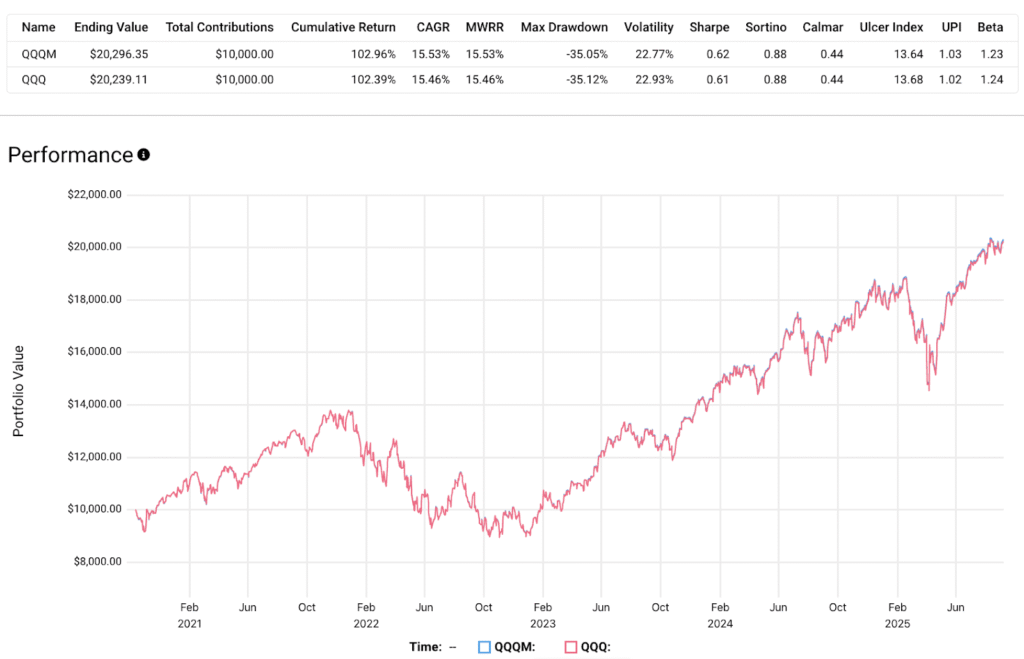
History doesn’t repeat itself, but it often rhymes, as they say. Since QQQM’s launch in late 2020, we’ve got about five years of data to chew on. From October 13, 2020, to January 8, 2026, QQQ delivered a cumulative return of roughly 111.88%, while QQQM edged ahead at 112.25%.
Annualized, that’s 15.41% for QQQ and 15.45% for QQQM. Not a huge gap, but it shows how lower costs can compound positively. During bull markets, both surged with the tech boom, but in volatile times like 2022’s dip, they moved in lockstep.
To visualize this, here’s a performance chart comparison:
Volatility and Risk Profiles
No investment is a smooth sail; there’s always some chop in the water. Both funds show similar volatility, with annualized standard deviation around 22.55% for QQQ and 22.40% for QQQM over the period. That means expect ups and downs, but nothing wildly different between them.
Risk-wise, since they hold the same stocks, their beta to the market is nearly identical – about 1.2, meaning they’re a bit more volatile than the S&P 500. For risk-averse folks, diversification elsewhere might help, but for growth seekers, this is par for the course in QQQM vs QQQ performance.
Liquidity and Trading Efficiency
Liquidity is the lifeblood of trading, right? QQQ wins hands down here, with average daily volume in the tens of millions. It’s a favorite for day traders and options enthusiasts because spreads are tight, often just a penny or two.
QQQM, while respectable at millions of shares traded daily, doesn’t match that yet. However, for long-term investors who aren’t flipping shares hourly, this matters less. In fact, QQQM’s lower volume hasn’t hindered its performance, proving that sometimes, slow and steady wins the race.
Dividend Yields Compared
Both ETFs pay dividends, but they’re not income powerhouses – yields hover around 0.5-0.6% annually, as the Nasdaq-100 focuses on growth stocks that reinvest profits. QQQM might edge out slightly due to lower fees retaining more for distribution, but the difference is negligible.
If you’re chasing dividends, look elsewhere, but for total return, these yields are just icing on the cake.
Sector Allocations and Holdings
Diving into the guts, both funds allocate heavily to tech (51%), communications (15%), and consumer discretionary (12%). Top 10 holdings make up over 50% of assets, led by the “Magnificent Seven” tech stars.
This concentration can supercharge returns in good times but amplify losses in bad. Still, it’s this focus that has driven stellar QQQM vs QQQ performance historically.
| Aspect | QQQ | QQQM |
| Top Sector | Information Technology (51%) | Information Technology (51%) |
| Top Holding | Apple (~9%) | Apple (~9%) |
| Number of Holdings | 101 | 101 |
| Concentration in Top 10 | ~55% | ~55% |
Which ETF Fits Your Portfolio?
Choosing between QQQ and QQQM boils down to your style. If you’re into high liquidity and options trading, QQQ’s your pick. For cost savings and long-haul holding, QQQM shines. Both offer optimistic prospects in a tech-driven future.
Consider your horizon: Short-term? QQQ. Long-term? QQQM’s fees could pay off big.
Future Outlook for QQQM vs QQQ Performance
Looking ahead, the Nasdaq-100’s emphasis on AI, cloud computing, and biotech bodes well. With global innovation accelerating, expect continued growth. QQQM might pull ahead slightly over time due to costs, but both are poised for success.
In an optimistic light, as the economy rebounds, QQQM vs QQQ performance could reach new heights, rewarding patient investors.
FAQs
What is the main difference in QQQM vs QQQ performance?
The primary edge comes from QQQM’s lower expense ratio, leading to slightly better net returns over time, though holdings are identical.
Is QQQM better than QQQ for beginners?
Yes, its lower costs make it appealing for new investors building wealth gradually.
How do taxes differ between QQQ and QQQM?
QQQM’s ETF structure might offer minor tax advantages through in-kind redemptions, but consult a pro.
Can I switch from QQQ to QQQM easily?
Absolutely, but watch for capital gains taxes if not in a tax-advantaged account.
What’s the minimum investment for these ETFs?
Just the price of one share – around $624 for QQQ and $257 for QQQM as of early 2026.
Conclusion
Wrapping up our exploration of QQQM vs QQQ performance, it’s clear both ETFs offer a bright path to Nasdaq-100 exposure. With QQQM’s cost advantages and QQQ’s liquidity strengths, the choice hinges on your needs. In a world buzzing with innovation, investing in these can feel like betting on the future – and that’s an optimistic bet indeed. Whether you go with the veteran or the upstart, staying informed ensures you’re set for success in QQQM vs QQQ performance.